

« April 2007 Table of Contents
Case Study: Grocers sell convenience
Bars, chef stations, recipes and personal touch ease seafood purchases
By Lisa Duchene
April 01, 2007
Americans are increasingly seeking healthy, convenient
foods. Yet for most American consumers seafood is anything but
convenient. The protein presents an intimidating set of
variables in selection, flavors and cooking complexity.
The best retailers are finding ways to make seafood easier
to shop for and easier to cook. And when it comes to convenient
foods, smaller may be better. At Fresh Acres in Chicopee, Mass.
- a 25,000- to 30,000-square-foot concept store from Big Y
Supermarkets in Springfield, Mass., which opened a few months
ago - seafood, meat and deli are consolidated in the same
counter. The concept's premise is to offer time-pressed
shoppers fresh, natural and easily prepared foods all in a
smaller space to ease their shopping.
The Food Marketing Institute's Grocery Shopper Trends 2006
report finds increasing demand for ease of shopping. Store
features that showed the greatest gains in importance among
consumers were related to convenience: self-checkouts (16
percent of consumers surveyed in 2006 called this very
important versus 9 percent in 2005), an easy-to-shop store
layout (58 percent in 2006 versus 48 percent the prior year),
and fast checkout (60 percent of shoppers versus 50 percent in
2005).
Leading retailers like Whole Foods Market, H.E. Butt,
Wegmans and Giant Eagle are investing millions of dollars to
make grocery shopping a more pleasant, enjoyable experience for
customers. Culinary stations and open-kitchen chef
demonstration areas are also prominent features in many
stores.
Seafood doesn't get any more convenient than pulling up a
stool at a bar right in the seafood department. At the Whole
Foods stores in Austin, Texas, and Fairfax, Va., customers can
do just that: sit, order a crab cake or pan-seared fillet,
watch the chef cook in an open kitchen and even talk to him or
her about the product for sale just a few feet away. The Whole
Foods seafood bars represent the latest in-store twist on
"eatertainment," says Bob Sullivan, CEO of Plitt Seafood, a
Chicago distributor.
Consumers demand convenience, but ironically many will make
the time when it comes to "eatertainment." Many will also spend
the time when it comes to health and buying perishables.
"Yes, we're all time-starved, but we're also more willing to
invest our time giving serious thought to our [perishable]
purchases," says Marian Salzman, whose book "Next New: Trends
for the Future" was published in December. She is executive VP
and chief marketing officer for advertising agency
JWT
Worldwide.
"We want to know exactly what we're introducing into our
bodies, and particularly with fresh protein like fish we want
to know when and where it was caught. Fresh, local and natural
are growing priorities for all consumers," says Salzman.
Retailers would be wise to deliver convenience, but not at
the expense of those attributes. The answer, suggests Salzman,
lies in fresh versus frozen.
"There's a point when we get to the frozen center of yet
another cookie-cutter fish steak that we say, 'Enough!'"
Freshness, quality and all-natural are paramount for seafood
departments, says Michael Kennally, VP of seafood for Price
Chopper Supermarkets in Schenectady, N.Y.
Price Chopper delivers convenience to its seafood consumers
in two important ways, says Kennally. Customers can always get
fish fried (in trans-fat-free oil) to order out of the seafood
case, a popular item, especially when promoted for $3.99 a
serving, drawing a "tremendous" amount of people, he says.
Then, there are old-fashioned, one-on-one conversations with
shoppers at the chain's 116 stores. Price Chopper's seafood
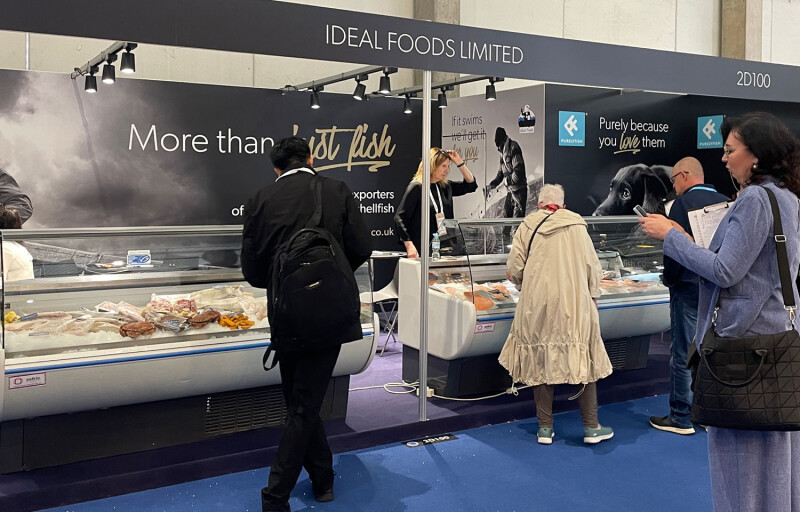
cases open in the front so that counter staff can talk with
customers and point out the products inside while standing with
them in front of the display.
"We get side by side with our customers and that's the only
way you can help them," says Kennally. In this way, counter
staff help customers pick out a fillet or steak, give them meal
ideas, often handing out recipe cards. "We love doing that.
When you can do that and get that customer real excited about
what they're buying, that's great."
Town and Country Markets and Central Market, with six stores
in greater Seattle, takes the same approach as Price Chopper.
Often, the counter staff gets to know the customers by name and
over time learns their lifestyle and preferences in order to
suggest how much and what kind of fish they need, says Chris
King, seafood specialist.
"Experience with the customer," says King. "That's ease of
shopping. We know people. We know what they want. We know how
much they eat."
Product assortment, particularly value-added products, is
another way seafood retailers work to deliver convenience.
Retailers are devoting more real estate in their fresh seafood
cases to pre-portioned value-added products like crab cakes,
stuffed fillets, pre-marinated and otherwise ready-to-cook
fish, says Sullivan. At a Pennsylvania Wegmans in early
February, about one-third of the fresh case was devoted to
ready-to-cook items like pecan-crusted tilapia, stuffed salmon
and crab-stuffed mushrooms.
Bob Hartman, assistant deli and seafood director at Demoulas
Supermarkets, a 58-store chain in Tewksbury, Mass., says the
chain is selling more frozen, value-added products like bourbon
salmon and stuffed tilapia filets. The stores introduced the
products about a year ago and they've had a slow start, but
demand is increasing, says Hartman. "People want to cook fish,
but they're afraid to," says Hartman. "Value-added definitely
helps them out."
Helping out means providing the basics, like recipes and
menu suggestions.
The newest stores in the 197-store Hy-Vee chain, based in
West Des Moines, Iowa, added recipe displays to their seafood
departments (25 new stores and nine remodels are scheduled to
open in 2007).
Hy-Vee's seafood departments are adding recipe kiosks
because the company has seen increased demand for seafood, says
Chris Friesleben, Hy-Vee spokeswoman.
"We're just maybe coming into our own when it comes to
seafood, recognizing that our customers, we hope, are starting
to change their eating habits to include more seafood. We have
to step up to
the plate."
Clearly, the definition of convenience differs from one
retail chain to another, and keeping in tune with your
customers is paramount to discovering what is truly convenient
for them.
Contributing Editor Lisa Duchene lives in Bellefonte,
Pa.
Some of the recipes were developed in the store's test
kitchen, which also develops menus for consumers,
A 12-ounce , two-serving package retails for $3.99 to $4.99
for tilapia, add a $1 for salmon products.