
« October 2008 Table of Contents
The need for feed
Economics, environment drive fish feed
reformulations
By James Wright
October 01, 2008
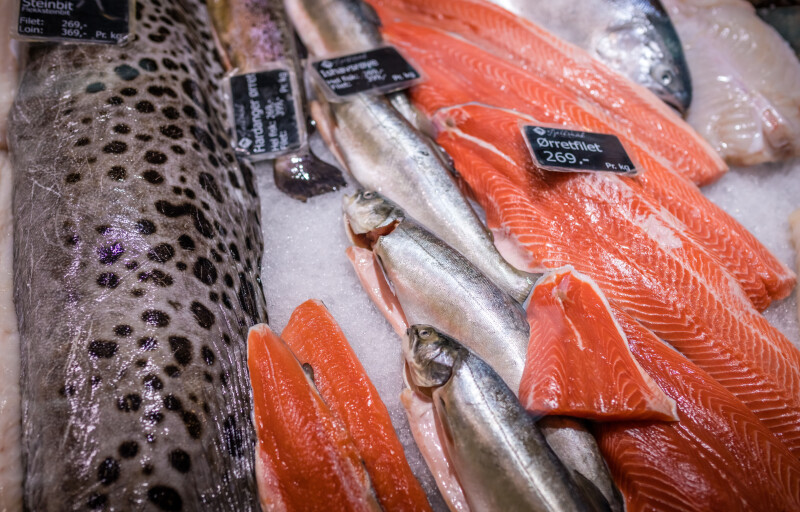
Stable pricing has given farmed fish a foothold with U.S.
seafood buyers, who also like the consistent quality and
year-round availability. But over the past year, prices for
many of the United States' most popular farmed seafood species
- including Atlantic salmon, catfish and tilapia - have risen,
and a major reason why is the cost of fish feed. Since 2005,
prices for major feed commodities have roughly doubled, and in
just the past
12 months, fishmeal prices have skyrocketed,
increasing up to 125 percent.
Because corn, soy, wheat, canola, fishmeal and fish oil are
all increasingly expensive, farmed fish aren't likely to get
cheaper any time soon, especially now that livestock and fish
farmers, the primary fish oil buyers, are competing against a
growing field. The popularity of nutritional supplements
containing omega-3 fatty acids from fish oils and the
burgeoning alternative fuels market - not to mention the
turbulent rise in petroleum costs - have established a new
pricing dynamic.
On top of it all, producers of carnivorous species like
salmon must address mounting non-governmental organization
(NGO) concerns that their fish simply eat too many fish. Global
forage fisheries that are harvested almost exclusively for
fishmeal and fish oil reduction, including Peruvian anchovies
and U.S. menhaden, are in heavy demand. Securing a nutritious
and sustainable feed supply is quickly becoming the aquaculture
industry's top priority.
"Feed can make you or break you in the production world,"
says John Schramm, president of Tropical Aquaculture in
Rutland, Vt., a vertically integrated tilapia producer that
manufactures about 20 percent of the feed used on its farms in
Central and South America. "Efficiency is paramount in the
survival of an aquaculture operation."
To lower costs, Tropical and other fish farmers work with
feed manufacturers to reformulate fish feed's blend of protein
and other key nutrients to grow healthy, high-quality fish at
an affordable price. However, that is becoming a difficult
task. According to a 2002 report by the Virginia Cooperative
Extension, a joint program between Virginia Tech University and
Virginia State University, fish feed represented 40 to 50
percent of production costs for global finfish aquaculture
operations. Most sources interviewed for this story say it's
now more than 60 percent.
"The industry is under pressure to reduce [fishmeal]
inclusion rates. We used to use 20 percent fishmeal and now
it's closer to 10 percent," says Joshua Goldman, managing
director of Australis Aquaculture in Turners Falls, Mass., the
United States' largest barramundi producer. "But at a certain
point you can't keep doing that."
The price of fishmeal, Goldman notes, jumped from $800 a ton
last year to $1,800 a ton in recent months. The increase is one
factor prompting Australis and other aquaculture companies to
seek alternative sources of protein and other nutrients for
their feed.
"It's always a balance," Goldman says. "Science always tells
us we can use less of these ingredients than what we find is
practical in the field. It's pushed us in the right direction
in terms of sustainability. But we can't risk performance."
Reducing dependence
Both economics and the environment influence feed prices as
well as the level of reformulation activity, says Chris
Beattie, sales manager for Skretting North America in
Vancouver, British Columbia. Skretting, a subsidiary of
Nutreco, one of the world's largest feed manufacturers, has
experimented with protein substitution techniques for two
decades.
"Like a lot of things, [reformulations] don't necessarily
come into play until economics put you on that route," he says.
"Now every day I have a conversation about some kind of
nutritional aspect or [protein] substitution."
With commodities becoming increasingly volatile in price and
availability, manufacturers must balance their feed's
nutritional needs with affordability. And the competition among
feed providers is fierce, says Beattie.
"It's almost like a perfect storm of everything we use [in
our feed]," Beattie says. "Economics will always be a big
driver in feed formulations."
Finances were an afterthought when Kona Blue Water Farms in
Kailua-Kona, Hawaii, decided to reduce its dependence on the
world's forage fisheries, says company President Neil Sims.
When Kona Blue began raising Kona Kampachi®, a yellowtail
relative, several years ago in net pens off Hawaii's Big
Island, the fish were fed pellets comprising 80 percent
fishmeal. Like Atlantic salmon, kampachi require a diet
reflecting its wild cousin's, which until recently meant a
heavy reliance on fishmeal.
Knowing this dependency was one of the environmental
community's chief complaints about farming carnivorous species,
Kona Blue decided in 2006 to reformulate its feed to about 50
percent fishmeal and fish oil. Two subsequent reformulations -
the latest coming this August - reduced the feed's fishmeal
content to 20 percent, with poultry byproducts filling in for
the losses in proteins and essential amino acids.
It was a decision their environmental consultants applauded,
but it cost the company one of its major customers.
Natural-foods retailer Whole Foods Market subsequently removed
kampachi from its seafood counters because its policies don't
allow for farmed fish to be fed land-animal byproducts.
"We talked with Whole Foods extensively. They weren't
interested in changing their policy," says Sims, "There are
vegetarians out there who still like to eat fish, but they
don't want to eat fish that eat land animals."
Kona Blue, however, had its eyes on a bigger prize: a "good
alternative" rating from the Monterey Bay Aquarium's Seafood
Watch program, a consumer-based pocketsize seafood buying guide
that determines what it says are the most responsible seafood
choices regarding sustainability, food safety and environmental
impacts.
"It's very important to us to be in a position of
leadership," says Sims. "But to have that broader recognition
in the marketplace with the MBA ranking is a tremendous
response. The fact that this is achievable is a huge step
forward for this industry and should change the tone in the
debate about the ecological viability of growing fish in the
ocean."
The makeup of fish feed, even for carnivorous species, will
change as researchers learn more about aquaculture, which is in
its infancy compared to livestock, says Diane Bellis, Ph.D., a
researcher with AgSource in Washington, D.C.
"We have a very limited understanding of what fish need,"
says Bellis, who is a consultant for the United Soybean Board
and collaborated with Kona Blue during its feed trials.
"Chicken, they're all genetically the same. That's just not
true of fish."
Bellis is bullish on soy's potential use for aquaculture
feeds, including the development of orange-hued soybeans that
could replace beta-carotene and other nutrients used in salmon
feed to give the farmed fish their customary orange color;
otherwise, the flesh would be gray and unappealing.
"[Soybean] farmers see the aquaculture market as a big
opportunity," she says. "But that's not to say it won't come at
a premium."
The price of soybeans has increased tremendously over the
past several years. According to the USDA's National
Agricultural Statistics Service (NASS), the average U.S. price
of soybeans increased from $4.38 per barrel in 2001 to $10.40
per barrel in 2007.
Higher feed costs are hitting the farmed salmon industry
particularly hard, especially in Chile, where growers are also
wrestling with infectious salmon anemia (ISA), a disease that
spread quickly after first being detected there in July 2007;
ISA, while harmless to humans, also arose in Norway and Canada
in years past with devastating effects. One producer of farmed
salmon from Chile says worldwide fish oil demand for
nutritional supplements is making it challenging to remain
profitable, adding that salmon feed prices are up 32 percent
this year compared to last.
"Higher feed costs, coupled with the challenges Chile has
faced with ISA, will make for a rough year or two," says Jason
Paine, VP of sales and marketing at Multiexport Foods' Miami
office.
The right direction
A commitment to environmental needs will pay off, says Becky
Goldburg, director of marine science at Pew Charitable Trusts
in Washington, D.C. Moving toward alternative feed ingredients
is the most important challenge facing the aquaculture
industry, she says, because it is a global issue. For
carnivorous species, essential long-chain omega-3 fatty acids
come only from marine sources. Therefore, reduction fisheries
are crucial, but the aquaculture industry's awareness of its
dependence on them is growing, Goldburg says.
"In terms of a global footprint, feed is probably the
aquaculture industry's biggest - [about] 33 percent of world's
fisheries go to reduction for fishmeal," Goldburg says. "And
there's now some evidence that some reduction fisheries may be
expanding because of demand for fishmeal worldwide."
Matt Elliott, senior associate at California Environmental
Associates, a San Francisco consulting firm that is working
with the David and Lucille Packard Foundation and its
sustainable seafood research, says global animal production is
increasing 3 percent annually. Aquaculture is growing at a 9
percent annual rate, he says, and not even a lack of fishmeal
can stop its expansion.
"Science is improving the
ability to substitute other
products for fishmeal and fish oil," Elliott says. "All the
major feed producers recognize this. It's in their interest to
investigate all the substitutes. It's the direction the
industry has to head in. The challenge is to make it cost
effective."
The United Nations' Food and Agriculture Organization
reported earlier this year that demand for fish oil will
strengthen in the near future for both animal feed and for
human consumption. "A price level of $2,000 a ton will be
considered an average price level, with some room for upward
movement," the report stated.
"The fact that everyone has started to take fish oil pills -
the aggregate effect of that is a significant variable," says
Goldman of Australis Aquaculture. "Nutritional use is up. And
all of the oils [we're] competing with are up."
Global fishmeal production is dominated by Peru, followed by
Chile, China, Thailand and the United States. According to the
International Fishmeal and Fish Oil Organization, a United
Kingdom-based nonprofit group that represents fishmeal
producers worldwide, Peruvian anchovies represented 29 percent
of all fish stocks used in global fishmeal production from 2002
to 2006. U.S. menhaden and pollock represented only 5 percent
combined.
"If we're going to increase the scale of open-ocean
aquaculture, we can't do that on the backs of Peruvian
anchovetta," says Sims.
But if commodities are already fully exploited, where will
feed ingredients come from to fuel the industry's growth?
"There's not a panoply of options now, but investment in
technology by government could play an important role in
creating better fish feeds for the future," says Goldburg.
Because of price, soybeans and other agricultural commodities
"are less attractive alternatives than they used to be," she
says.
"Some members of the aquaculture industry are making
considerable progress [with reformulations], even some of the
salmon farmers," says Goldburg. "Part of it is a price issue,
so there's an incentive to reduce inclusion."
Trading catfish for corn
Despite a far lesser dependence on fishmeal and fish oil,
producers of catfish, tilapia and even shrimp are paying more
for feed.
Schramm, of Tropical Aquaculture, says his feed costs jumped
in the last year from $320 to $530 a ton. All other costs
aside, he says, feed costs are responsible for a 50-cent
per-pound increase in Tropical's fresh tilapia fillets, and
fuel is responsible for another 30- to 50-cent increase.
"It's all about managing your input for the highest output,"
Schramm adds. "But are we [as an industry] more responsible
about how we farm as opposed to 10 years ago? Absolutely."
Unsurprisingly, fuel is a major influence on agricultural
products. According to NASS, U.S. farm production expenditures
increased 9.3 percent last year compared to 2006 and nearly 30
percent compared to 2001. Farmers are paying more for not only
petroleum, but also for fertilizer products, chemicals and
transportation services. And indirectly, NASS says, growing
demand for ethanol from corn has led to higher crop prices,
resulting in increased costs for livestock and aquaculture
feed.
The increase has hit the domestic catfish industry
particularly hard, forcing more farmers to leave the business.
A Mississippi State University economic report from August
found that catfish feed prices increased from $250 a ton last
year to more than $400 a ton this year. Even as live fish
prices increased from about 70 cents per pound to more than 80
cents, many catfish farmers simply couldn't come out ahead and
are draining their ponds to plant corn.
The major question remains, how much higher can the price of
feed commodities go, and, in turn, the price of farmed fish? It
appears there is no ceiling.
"Nobody's saying the price of energy is going to go back to
where it was," says Bellis of AgSource. "I'd say protein is the
same way, whether it's fishmeal or soybean meal. What's
important [for fish farmers] is to have as many options as
possible."
Add to that a customer base willing to pay higher prices for
fish.
"Thankfully, [price increases are] being accepted and
understood, because it's something we have to do to stay in
business," says Rob Mayo, president of Carolina Classics
Catfish in Ayden, N.C.
Assistant Editor James Wright can be e-mailed at
jwright@divcom.com