

« August 2008 Table of Contents
Case Study: Making a case for retail
Consumers are stretching their dollars as food prices soar
By Lisa Duchene
August 01, 2008
Jim Wallace has seen recessions come and go. But this one is
unique, says Wallace, VP of perishable procurement with C&S
Wholesale Grocers, a Hatfield, Mass., company serving 5,000
grocery stores in 12 states.
When fuel prices skyrocketed three decades ago, fish was
much more plentiful than it is today, says Wallace. With a weak
dollar and strong overseas demand, it's become very difficult
to secure fresh, quality seafood, leading to high prices just
as consumers are looking to stretch their food dollars, he
adds.
"I think everybody's kind of in survival mode right now, to
be honest," says Wallace. "Supply of good, fresh product is
limited."
Record high prices for gasoline, food price inflation, a
slumping housing market and weak employment figures all hamper
the U.S. economy. But rising from the doom and gloom is one
critical opportunity for supermarkets: Americans are turning to
retail to economize.
Seventy-one percent of the 2,020 U.S. shoppers surveyed in
January by Harris Poll Online for the Food Marketing Institute
said they are eating out less and cooking at home more.
Families eat their main meal out 1.2 times per week, down from
1.3 in 2007 and 1.5 in 2006, according to FMI's "U.S. Grocery
Shopper Trends 2008."
"This presents retailers [with] an opportunity to win back a
share of the meal-time market long owned by restaurants," says
FMI's President and CEO Tim Hammonds.
Whether that opportunity extends to the seafood department
depends on whether retailers present - and consumers view -
seafood as a good value.
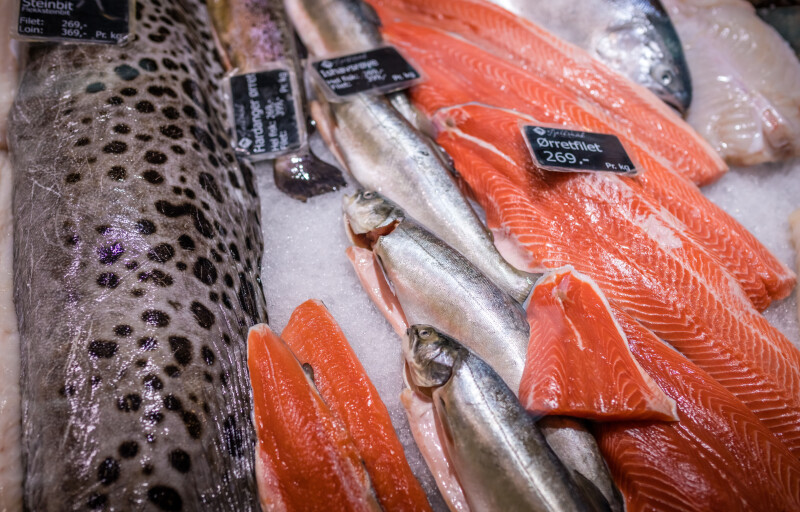
The top-dollar items like shrimp, king crab and snow crab
that typically generate a lot of sales are hurting, says
Wallace. Some retailers, he says, are responding with a
two-tiered merchandising strategy to appeal both to consumers
who view seafood as an affordable indulgence as well as to
those who are pinching pennies. They are balancing a selection
of fresh and frozen products, like tilapia fillets.
"As long as we continue to portray ourselves as a value, we
can compete for the center of the plate," says Wallace.
Most consumers are "trading down" in their food purchasing,
says Jim Hertel, managing partner of Willard Bishop, a retail
consulting firm in Barrington, Ill. As prices rise, says
Hertel, consumers typically will not increase their food budget
but will find ways to stretch the same spending level by
purchasing less expensive products, often turning to store
brands.
Everybody is affected in varying degrees depending on their
household income. Consumers in the top 20 percent income
bracket probably haven't changed their food purchasing all that
much. People in the upper-middle class, or earning north of the
median income of $48,200, are likely to have cut their visits
to restaurants and might be trading down from a premium product
like ahi tuna to farmed salmon. Depending on pricing, others at
lower household income levels may be trading out of seafood,
says Hertel.
That scenario worries Ken Chapin, meat and seafood director
at Yoke's Fresh Markets, a 12-store chain based in Spokane,
Wash. "What we're seeing is the beginning of a softening," he
says. Sales increases are not as robust now as they have been
the past few years; the retailer recently had healthy seafood
sales increases after spending several years improving its
seafood departments.
Chapin notes Yoke's customers are trading down as they
purchase meat, but in seafood, "I don't see where there's a
huge trade-down option."
While Chapin says Yokes' customers are just starting to
react to the weak economy, plenty of them are still paying a
non-promo price of $17.99 for whole Copper River salmon.
"People are coming in and asking for it," he says. Chapin is
reviewing various strategies to weather the downturn but sees
no reason Yoke's should waiver from its commitment to
seafood.
One seafood merchandiser at a Midwest chain has seen sales
drop 7 percent compared to last year. Overall, business seems
to be returning to 2005 levels, he says.
"Everybody's been double-digit, double-digit and all of a
sudden the bottom's falling out," says the Midwest
retailer.
Pushing the value of seafood is definitely the answer, says
the retailer, who is reminding customers that there is little
to no waste with seafood, and is testing per-portion pricing.
Grouper fillets are advertised at $6.37 per portion instead of
$16.99 per pound, so that a consumer can easily see that $13
serves two people. He is also careful to promote fewer items
than he would have last year, but offer a deeper price cut on
those key items.
Those steps are right in line with what Hertel is
recommending supermarkets do to navigate the recession. Most
retailers are looking at their mix of premium and value
offerings and expecting flat sales for the near future, he
says. As the cost of goods increases, Hertel suggests retailers
listen to shoppers, look for opportunities and avoid simply
passing on price increases to safeguard margins.
"You might want to merchandise the convenience foods
offering restaurant quality with a made-at-home price," says
Hertel. "Be conscious that people are going to be looking for
these opportunities and make it easy for the shopper to realize
that a given store has something that maybe they thought was
priced out of their reach but really isn't."
Contributing Editor Lisa Duchene lives in Bellefonte,
Pa.