

« April 2008 Table of Contents
The fine print
Retailers adjust to country-of-origin labeling, while
restaurants fear they're next
By James Wright
April 01, 2008
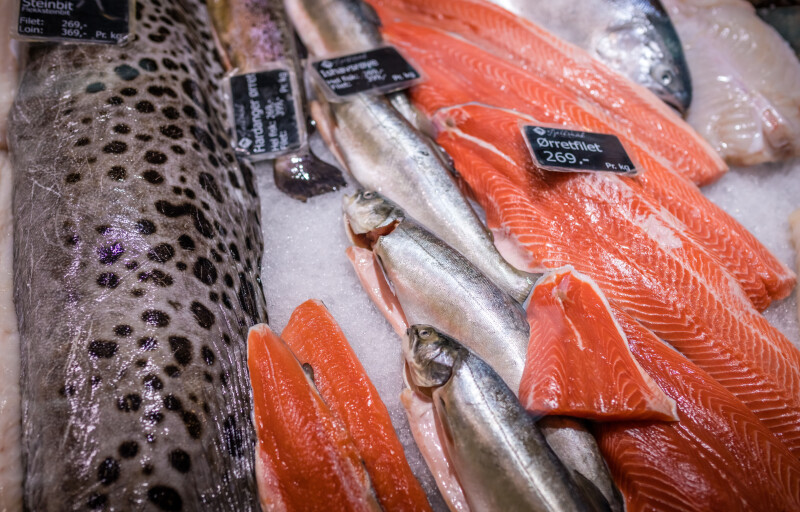
Three years ago this month, U.S. retailers were required by
law to label all seafood products with their country of origin
and method of production (whether wild or farmed).
Country-of-origin labeling legislation, known simply as COOL
since its inception as part of the controversial 2002 Farm
Bill, was the federal government's answer
to mounting consumer
and political appeals for greater transparency in the food
supply.
Unfortunately, the onerous duties of recordkeeping,
infrastructure upgrades and employee training, which were split
between retailers and their seafood suppliers, became more
costlier endeavors than
the U.S. Department of Agriculture
initially predicted. And if the results of the agency's first
two COOL audits are any indication, complying with the program
is proving more difficult than envisioned.
According to the USDA's Agricultural Marketing Service, 36
percent of the nearly 3,000 retailer reviews it conducted in
2006 and 2007 discovered violations - an average of nearly two
violations per review - ranging from inaccurate labeling to
failure to keep adequate records. The growing pains associated
with seafood COOL are evident in the numbers (see chart, p.
28), yet retailers may continue to struggle because, as of
Sept. 30, all center-of-plate proteins, peanuts and produce
must become COOL compliant.
Early criticism of the labeling law centered on high
compliance costs for large retailers and whether or not the
program would improve food safety. Political pressure kept the
spotlight on seafood, as Sen. Ted Stevens (R-Alaska), the
influential chairman of the Senate Appropriations Committee,
pushed for seafood to be the first commodity under COOL to
protect Alaska's wild seafood industry. Now, there's a growing
movement to expand COOL parameters to include foodservice,
largely because the majority of seafood consumed in the United
States is at restaurants.
The concept has gained the most traction in the South, where
catfish farmers and shrimp fishermen continue to toil in
competition against less expensive imports. Economic fraud at
the region's restaurants has flourished in the form of species
substitution (See SFB June 2007 Top Story, "Tricks of the
Trade").
In Alabama last year, a bill was introduced that would
require foodservice operators to provide origin labeling upon
customer request; proposed legislation in other Southern states
would require mandatory participation.
Attention to seafood origins increased dramatically in the
wake of last year's food-safety crisis in China, when the U.S.
Food and Drug Administration placed Chinese producers of five
farmed-seafood species - including shrimp, basa and catfish -
on import alert for repeated use of banned veterinary
drugs.
Experts expect the push for more information about seafood -
regarding food safety, sustainability, carbon footprints or
food miles - to only increase.
"With all the issues that have faced the [seafood] industry
over the last year, I think consumers welcome the opportunity
to know the country of origin. The consumer, in the end, is the
beneficiary," says Tom DeMott, COO of Encore Associates, a
retail-consulting firm in San Ramon, Calif. "I think the world
is adjusting to COOL. It's not going away - right, wrong or
indifferent."
American consumers clearly want country-of-origin labeling.
In a June 2007 Consumer Reports survey, 92 percent of
respondents said imported foods should be labeled with country
of origin. The poll sampled 1,004 people on issues concerning
food safety and labeling. Subsequently, Consumers Union, the
magazine's non-profit publisher, called for COOL to be put into
effect immediately for all imported food. Several other surveys
have drawn similar conclusions.
With mounting media interest and political pressure, COOL on
restaurant menus appears inevitable.
"The way our food is being scrutinized right now, I think
[COOL for foodservice] is a very real possibility," adds Joseph
Sabbagh, president of Sax Maritime Associates, a retail
consulting firm in Los Angeles. "I don't think just retailers
should have to bear the brunt of this."
Ken Conrad, chairman of Libby Hill Seafood Restaurants in
Greensboro, N.C., and the North Carolina representative of the
National Restaurant Association, likens COOL on restaurant
menus to a "nightmare" even though his company could easily
provide sourcing information. The problem is, it costs $4,000
each time his menus change.
"It's somewhat like nutrition labeling. It should be
[available] somewhere on site, but not on the menu on a daily
basis," says Conrad. "[Restaurants] have so many concerns
running a day-to-day business, so many big and little problems,
we just don't need another one right now."
Costs and benefits
To Sabbagh, who consulted with retailers like Whole Foods
and Wild Oats for nine years combined, COOL compliance is all
about recordkeeping and training.
"You really should, in this day and age, be tracking where
your food is from," he says. But when it comes to complying
with the regulations, being large is not necessarily
advantageous. While supermarkets, club stores and large
independent retailers are each subject to COOL and face unique
challenges, the larger the operation the greater the logistical
headache.
The same can be said for
the expense.
Last March, the Food Marketing Institute of Washington,
D.C., reported that COOL compliance cost retailers up to 10
times more than the USDA originally estimated and had not
increased sales of domestic seafood as many supporters had
hoped. FMI polled more than 1,000 stores and found that seafood
COOL compliance cost an average of $9,000 to $16,000 per store
in the first year, compared to the USDA's estimate of $1,530.
Seafood suppliers, according to FMI, were hit even harder, as
their compliance costs averaged $200,000 to $250,000 in the
first year, compared to the USDA's estimate of $1,890.
DeMott, of Encore Associates, says the greatest costs - and
greatest opportunities for mistakes - are incurred when the
source of a particular seafood product changes by either
seasonal or other availability factors. Complicating matters is
the fact that more than 80 percent of the U.S. seafood supply
is imported.
"If you want to buy scallops, for example, you can get them
all over the world. As a buyer, you want to have a quality
standard, but you also want to know where and who it's from.
But say you change your source from [the United States] to
China and then to Argentina - each time you have to label that
product differently at the store level. It becomes a different
item," says DeMott.
"Retailers are loath to make such changes. [COOL] forces
their hand to buy from a certain area. It's faster to make a
buying decision than to switch the country of origin on all
your labels, I can tell you that."
For some retailers, the new law simply validated their
long-standing practices of keeping detailed records and
providing thorough information for customers.
"Wegmans provided country of origin labeling long before it
was required," said Jeanne Colleluori, communications
specialist for Wegmans, a 70-unit retail chain based in
Rochester, N.Y., via e-mail. "Our employees (and signs) have
talked about country of origin as a way to tell the story of
the products that make us proud."
DeMott says independent retailers may be more "nimble" than
big box chains, to which Paul Johnson, owner of Monterey Fish
Market, a Berkeley, Calif., wholesale and retail outlet, can
attest. Johnson says COOL fosters honesty and long-term
relationships. His retail and wholesale customers appreciate as
much information as he can provide, which may even include the
name of fishermen who landed that day's catch. He does it all
even though, as a small retailer, he's not required to by law
(see Editor's Note, p. 6).
"It's important to keep the consumer informed, even taking
it one step further and saying exactly where [the fish] is
from. Any way you can label seafood is good, like the [National
Shellfish Sanitation Program]," says Johnson, who believes the
benefits of the federal labeling law transcend the costs.
"We're a small business, so we don't have the problems of a
Safeway or another big institution," adds Johnson. "But I just
don't believe that it costs that much. What's so expensive?
When big companies go from full-service to prepackaged fish
counters, think how much more that costs in terms of packaging.
Where they save is in labor. So for the company it's a good
deal. But for the consumer it's not such a
good situation.
"There's also a tradition of obfuscation in the market. If
you say you've got 'Taiwan tilapia,' [consumers will] be less
apt to buy it than if it were from Arizona."
Restaurants remain spared
Instead of waiting for the federal government to mandate
COOL for foodservice, some states are taking the matter into
their own hands, especially in the South, where origin labeling
has become a political football. Those rallying in favor of
foodservice COOL stand accused of protectionism; those opposed
say the law won't increase food safety or sales of domestic
seafood. U.S. Rep. Bob Goodlatte (R-Va.) last year derided COOL
as "simply a bad idea" that is strictly a "marketing
issue."
The two seafood species at the center of the COOL debate, to
little surprise, are catfish and shrimp. With the respective
domestic industries struggling to compete against imports,
despite protective tariffs resulting from antidumping
petitions, politicians in the region are leveraging COOL to
attack imports and spark consumer interest in buying local.
Last year, U.S. Rep. Bennie Thompson (D-Miss.) said it's "an
outrage that Americans who legitimately order 'catfish' or
'farm-raised catfish' in restaurants are unknowingly eating"
imported fish. COOL is a "matter of public safety and consumer
choice," he said, alluding to the import alert against China
last summer.
Also last year, Alabama state Rep. Spencer Collier
(R-Irvington) introduced a bill that would require
restaurateurs to reveal the source of its seafood; it was the
fifth time that Collier had filed the bill, which remained tied
up as of press time.
If passed, menus in the state would have to print this
statement: "Upon request, the customer has the right to know
the country of origin of the seafood served in this
establishment."
And just last month, Georgia state Sen. Ronnie Chance
(R-Fayette) introduced legislation that would require COOL for
seafood in his state's restaurants.
Eddie Gordon, executive director of Wild American Shrimp in
Charleston, S.C., supports COOL for restaurants as a consumer
as well as from a business standpoint. The lettering on labels
should be larger and bolder, he says, to hold everyone in the
supply chain accountable.
"It's a worldwide movement, yet the seafood industry is
dragging its feet once again. What's wrong with saying where
your seafood is from?" says Gordon. "Restaurants will have a
choice: They can do it voluntarily or they'll be left in the
lower echelon. To keep fighting like cats and dogs over this
issue doesn't make sense. The rest of the world is leaving us
behind."
Conrad, of Libby Hill Seafood Restaurants, says the
restaurant industry would fight COOL if legislation advances to
a federal level. "We'd use some political bullets," he
says.
There are contentious aspects within the federal COOL
language itself. The law requires that the proper country of
origin of any given seafood product is not necessarily where it
was harvested, but where it was last processed. For example, on
6-ounce cans of Bumble Bee Wild Alaska Pink Salmon, the labels
read, "Product of Thailand." (Bumble Bee parent company Connors
Bros. Income Fund of Markham, Ontario, owns a 10 percent stake
in Thai tuna processor Sea Value Co.)
But instead of battling imports, one domestic group is
focused on building an origin-based brand in an effort that
goes beyond marketing. Pat Shanahan, program director for
Genuine Alaska Pollock Producers in Seattle, says origins are
mandatory for institutional foodservice, pointing to the "Buy
American" provision of the
National School Lunch Act, which
requires school food authorities to "purchase domestically
grown and processed foods, to the maximum extent practicable."
GAPP is now instructing school buyers to request Alaska pollock
and to look for the GAPP logo.
"Schools can't tell if they are complying with the law. We
wish it was transparent. It would
help schools if they could
tell [where their products are from]," says Shanahan.
"We're competing against Russian product," she adds, "but
Russian pollock is also called Alaska pollock, which is very
misleading. Consumers are confused. As a consumer, I'm confused
- I want to know where my food is coming from. So GAPP serves
as a voice for Alaska pollock, the fish that many people are
eating but nobody knows they're eating it."
Audits reveal weaknesses
Despite a three-year head start on other commodities like
beef and poultry, retailers and the seafood industry have room
for improvement on COOL compliance, says Martin O'Connor, chief
of the U.S. Department of Agriculture's Agricultural Marketing
Service, the federal agency responsible for enforcing COOL.
"There's always room for improvement. With the outreach that
was done within the [retail] industry and its respective
associations, many [stores] were well prepared at the outset,"
says O'Connor.
In 2006, the first year that the USDA conducted retail
seafood COOL audits, 40.5 percent of the reviews revealed
labeling violations; the percentage dropped in 2007 to 32.6
percent. The most common violation was failure to label the
method of production (wild or farmed). Willful violations
warrant fines of up to $10,000.
"Any improvement in 2007 was due to familiarity with the
program," says O'Connor, noting that 68 percent of reviews of
2006 offenders made all the necessary corrections the following
year. "Retailers were more knowledgeable of the spirit of the
regulation itself. There were indications in certain places
where improvements could be made but the general consensus was
that the majority of products were
labeled properly."
Sabbagh, of Sax Maritime Associates, says the complexity and
wide variety of seafood products presents so many opportunities
for mistakes that proper training is essential.
"Execution at the store level list is not all that good.
Take shrimp: If the country of origin changes, and it often
does, the manager has to be on top of that and make sure the
people filling the case understand it. Full-service counters
have a lot of labels, a lot of opportunities to fail," Sabbagh
says.
"There's nothing wrong with too much information - there is
something wrong with needless and inaccurate info. That's what
the food industry suffers from."
Assistant Editor James Wright can be
e-mailed at
jwright@divcom.com