
« April 2008 Table of Contents
Case Study: Size matters
Seafood's variety sets it apart, but how much is too much?
By Lisa Duchene
April 01, 2008
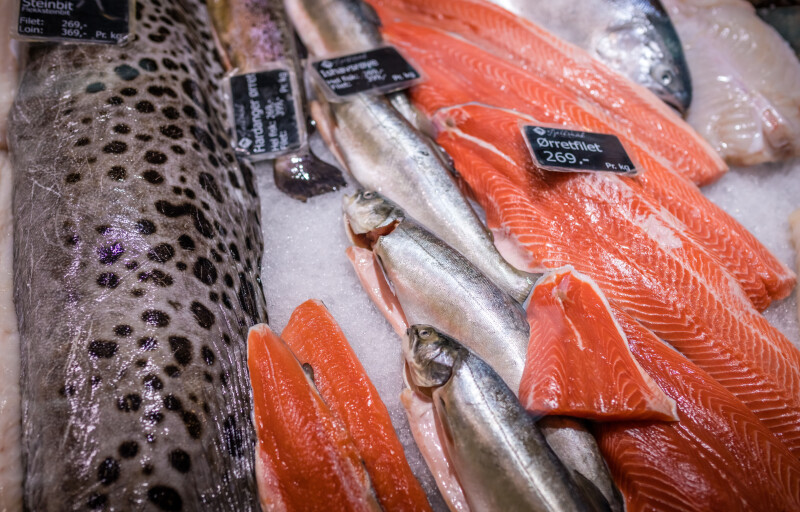
Shoppers have a wide variety of seafood options at the Stew
Leonard's store in Danbury, Conn. A 40-foot fresh bar stacked
on ice and 16-foot freezer hold about 50 to 60 species totaling
more than 100 SKUs.
"[Customers] appreciate the variety," says Mike Reseska, the
store's seafood manager. "They're trying different things. It's
an image thing also. If a customer is going to shop our fish
counter and they see four or five varieties of fish they never
heard of, they're going to think, 'Hey, this is a real fish
market. Look at that hamachi, look at the Chilean sea bass and
the opah.'"
Like Stew Leonard's, every retailer must decide how many
seafood products to display. Miscalculate and the department
loses money. Plus, such a mistake will likely tarnish the
store's image as a good source of fresh fish at a time when
grocery stores want to be known for their perishables.
That's because going overboard on variety leads to shrink
and, well, shrink stinks.
Shrink is a huge indicator that the breadth of products is
too broad, says Joe D'Alessandro, senior director of seafood
merchandising for A&P. Since every company budgets and
accounts for shrink differently, there is no magic number.
Stew Leonard's carries one or two specials every week, like
a niche oyster or Nantucket bay scallops. "There's an educated
customer out there who knows seafood like it's the wine
business," says Reseska. "And that's oysters. Different places
and different tastes, all fascinating and unique."
For Reseska, keeping shrink in check starts with proper
ordering, which begins with watching the weather. A snowstorm
may cool sales while sunny weather bodes well for grill
favorites like swordfish and salmon steaks. If there is too
much of any one item, he'll cook it and hand it out as
samples.
Yet, a large variety isn't for every grocer, especially
those serving a demographic that is not seafood-savvy. (A
middle to upper-class, educated demographic in a coastal region
tends to be the most seafood-friendly.)
"You could look at a small case that had a relatively
limited assortment in it and if it was the right assortment you
could probably run a pretty profitable department with things
turning quickly," says Jim Hertel, managing partner of Willard
Bishop, a retail research firm in Chicago. "You may not be a
destination for seafood but you're satisfying routine needs
[and making money]."
Steve Lutz, executive VP of the Perishables Group, a
fresh-foods research firm in Chicago, cites the "80-20" rule
that about 20 percent of items make up the bulk of sales in any
department. He advises retailers to make sure they are getting
the top sellers right.
Just like the beer section's Budweiser and the produce
department's bananas, the seafood department has shrimp, salmon
and tilapia making up the bulk of its sales. Nailing those top
three is paramount, says Lutz.
"You can't sell enough whitefish to make up for what you
miss on salmon. You can't sell enough lobster to make up what
you'd sell on shrimp," he says.
Providing a narrow mix of products has been a hot topic
lately in food retailing, following U.K. retailer Tesco's late
2007 debut of its small-format Fresh & Easy, offering a
total of 3,500 SKUs compared to the average 45,000 offered at a
conventional supermarket. The Whole Foods and Giant Eagle
supermarket chains are both experimenting with smaller-format
stores (see Small Wonder, SFB March '08, p. 1).
But it's tough to determine the trend around variety in
seafood product assortment.
On one hand, grocers carried fewer seafood SKUs in 2007
(248) compared to 2006 (303), according to the Food Marketing
Institute, quoting research from Progressive Grocer . Bill
Greer, FMI's director of communications, attributes the finding
to an increasingly tailored product mix.
"There's a small margin of error in today's competitive
marketplace," he says.
On the other hand, for precisely the same reason, seafood
departments are expanding. Research conducted by Willard Bishop
in 2007 showed 77 percent of senior supermarket merchandisers
reported increasing the size of their seafood departments,
presumably adding products.
When it comes to the breadth of product mix, retailers must
first consider how committed they are to seafood, says Hertel,
and decide its primary purpose: Covering the basics? Being
known as the area's best source of seafood? Is it there solely
for profit? Or can it lose money because it contributes to the
overall store statement?
Next, advises Hertel, think about what you can manage. The
most common mistake retailers make in their seafood departments
is displaying a big assortment and expecting to make money on
every item in the mix, he says. That leads to hesitating to
toss fish that's not selling and the image-killing odor of
shrink.
If the seafood department is intended to be an image-builder
and destination, a broader variety - or at least the appearance
of variety - becomes more important.
Consumer research from the Perishables Group suggests
consumers decide product quality based on the appearance of the
case. Eighty-two percent of consumers surveyed while shopping
at a Northeast grocery chain named this as an important
purchasing factor, followed by service and product
selection.
Dorothy Lane Market, with three specialty stores in Dayton,
Ohio, just added a free-standing display case full of whole
fish. What doesn't sell is filleted and moved to another
case.
Says Jack Gridley, Dorothy Lane's seafood merchandiser:
"People see [the whole fish case] and it's like 'Wow, these
people are in the fish business.'"
The retailer's seafood SKUs expand and contract in cycles,
says Gridley. As Lent unfolds, there is a wide variety of items
compared to the rest of the year. And the overall selection of
products is greater and more specialized than a few years ago.
Previously, it would have been unthinkable to bring in fresh
sardines from Greece, as Gridley tries to do weekly. Variety,
after all, is seafood's advantage over other proteins, he
notes.
"I think people appreciate having more options," says
Gridley, "and I think they appreciate the opportunity to try
something new and different."
Contributing Editor Lisa Duchene lives in Bellefonte,
Pa.