

« May 2005 Table of Contents
Seafood University: The right image can spark sales
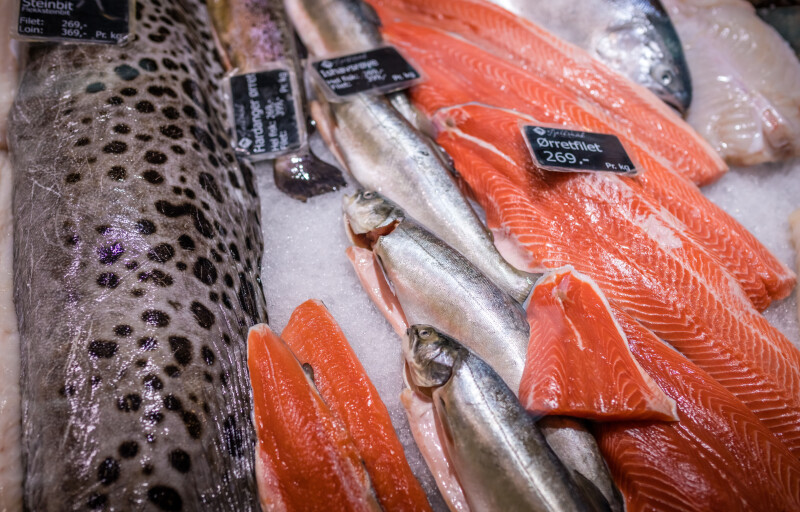
Do consumers see your product as an attractive meal option or dead fish on ice?
Lauren Kramer
May 01, 2005
Some departments in American grocery stores are changing rapidly, their
evolution fueled by smart marketing and positioning strategies that capture
consumers’ attention. Sadly, for the most part, the seafood department is not
among them.
“Fish looks cold and unappetizing in the display case, so it needs support
in terms of signage, recipe cards, labels and demonstrations to make it more
consumer friendly,” says Martin Roberts, president of GRID2, research and
design consultants specializing in retail.
Located at the back of the grocery store, the seafood department competes
with the meat and deli sections for consumers’ attention and frequently loses.
“At the average supermarket, the deli area is mobbed with customers ordering
cold cuts, but there is very little buzz or excitement in the fish department,”
observes Roberts. “People don’t linger, because it is cold and uninviting. It’s
an impulse-shopping section, so it needs to be highly visible, well lit and in
a high-traffic aisle in order to succeed. And it is not like that now.”
There are many strategies grocery stores could adopt to attract shoppers to
the seafood department, and not all are cost prohibitive. Tim Morrison,
supermarket studio principal at Little Diversified Architectural Consulting in
Charlotte, N.C., suggests chalkboards to notify customers of the catch of the
day.
“Display boards are effective in conveying where the seafood came from and
when it was brought in,” he says. “Also, if a seafood department is manned by a
staff member, this helps convey freshness and quality, which are key to a great
seafood department.”
Finding a knowledgeable sales associate can be a challenge, and it’s one
where independent grocery stores are typically more successful than large
chains, according to Julie Dugas, senior designer and associate at
Cubellismarco, a retail-design firm in Northville, Mich.
“It takes real commitment and effort,” she explains. “Most chains just focus
too much on operations and forget that they are actually retail and need to be thinking
like retailers. Concentrate on the customer,” she says.
Apart from a friendly face on the other side of the counter, the display
case holding the seafood, and in particular the organization of seafood within
it, can dramatically influence customer purchasing.
“We’ve found that the way product is presented to a customer can and will
have an effect on how much product is purchased,” says Dugas. “If the display
is powerful and fresh-looking, the perception will be that it’s good, and this
can help drive sales. Making sure that the product has good visibility, good
sight lines and adjacencies that make sense is also important to look at when
laying out the store plan.”
The choice of which perishables display case to use can be a crucial one for
grocery stores. For one of its clients, Pathmark, GRID2 made the display cases
open at the bottom, allowing shoppers to see under them, giving the suggestion
of cleanliness.
“Curved-glass fronts are preferable to straight, which have a mirror-like
reflection effect, and condensation sticks to the glass,” says Roberts. “Curved
fronts allow customers to get a very clear, condensation-free and slightly
magnified view of the fish. This, combined with strategic lighting that is very
bright and placed close to the display, gives the impression of fresher fish.”
Feng Shui experts have had some helpful advice for the seafood department
display, advocating that red fish be placed in the middle of the case.
“Red is the color that attracts the most attention, and it draws you into
the middle of the display,” says Roberts.
But price point is another factor in seafood display.
“When people first walk over to a case, if they see the most expensive items
first, they will walk away,” says Roberts. He suggests laying out the fish in
such a way that the lower price points are first. He also advises his clients
to divide the display case between impulse buys and other items.
“The shellfish are impulse buys and should be placed at the highest-traffic
location at the end of the display, preferably the right-hand side,” he says.
“In the middle of the display, customers should encounter fresh fish like bass,
snapper, salmon, trout and mahimahi.
The third section should be prepared meals, a selection of restaurant-style
meals that should all be the same price.
“And the cooked section comes next, prepared fish that is not packaged in
individual meals, where customers can buy fish by the piece.”
Seafood positioned in the front and center of the display case get the most
visibility, says Morrison, and smaller gourmet displays convey freshness better
than larger, unorganized ones.
There are two significant issues customers must overcome before they will
buy fish. One is the unappealing nature of the product, particularly once it is
cut into pieces and flattened onto Styrofoam trays. It’s difficult for shoppers
to connect this image to an appetizing, nicely presented fish dinner. Then
there’s the fact that many potential seafood-department shoppers simply don’t
know how to turn the product into a meal.
“Overall, people are frightened of buying fish. They don’t realize how easy
it is to cook and don’t know which types to buy. So to speak to today’s busy
consumer, fish needs to be marketed as a meal, not as dead things in an
ice-filled case,” says Roberts.
“At Williams Sonoma, fish images and recipes are included with their fish
kettle to show people that fish is appetizing. Mass-market retailers need to
think of ways to do the same, and signage is an excellent way to communicate
the versatility of fish.”
For Pathmark, GRID2 created large panels with images of prepared fish dishes
and suspended them from the ceiling in the fish department.
“Customers could look at the poster of paella or bouillabaisse and then
directly connect the fish in the display case with a meal they could prepare,”
says Roberts. “This type of signage inspires people to buy fish.”
Cooking demonstrations are another way to teach consumers how to prepare a
fish meal. Computer modules installed near the department, where shoppers can
type in a species of fish and print out recipes, are also extremely beneficial,
says Roberts.
He believes grocery stores should try to exploit Americans’ love of
barbecuing by encouraging them to grill fish.